
The long road of dharma.
Rama (Ram)
Rama is worshiped as an avatara of Vishnu and, in some traditions, as the Supreme Lord. Prince of Ayodhya, exile, warrior, husband, and king, he walks through questions of duty that do not become simple because he is divine. Infinite Hand turns to Rama for steadiness when dharma is costly, and for power that serves rather than possesses.
- Dharma
- Leadership
- Companionship
01 · Context
Exile, return, and the long argument of dharma.
In the Valmiki Ramayana, Narada names Rama to Valmiki as a person of virtue, truth, courage, gratitude, and firm resolve. Court intrigue sends Rama into fourteen years of exile, and Sita and Lakshmana go with him. After Ravana abducts Sita, Rama joins with Hanuman and the vanara allies, defeats Ravana, and returns to Ayodhya.
Rama's story lives through Sanskrit and vernacular Ramayanas, temple traditions, song, theater, festival, and household devotion across South and Southeast Asia. The name Ram may be spoken with intimate devotion, while Rama is the common English rendering used here. No single retelling contains every community's Rama.
Read the sources ↓02 · Infinite Hand’s reflection
What we take from it.
These are Infinite Hand’s interpretations. Bring your own reading to the conversation.
Keep faith with dharma
Dharma is more than obedience or reputation. Ask what truth, relationship, and responsibility require together, especially when every choice carries a cost.
Rule as service
Rama's kingship asks what authority owes to the people beneath it. Hold power as a duty of care, and do not make another person's dignity the price of public approval.
Walk with companions
Exile is not crossed alone. Honor the people who share the road, tell the truth, carry messages, and make return possible.
03 · The difficult part
An ideal king must still answer for the harm done in the name of rule.
A vow does not become righteous merely because keeping it hurts.
Rama's rejection of Sita after captivity and, in tellings that include it, her later exile remain painful and contested. A profile that calls him an ideal king must not hide Sita's humiliation or use dharma to silence her. Ramayana traditions debate and retell these events, and this profile keeps the question open.
04 · Bring it into today
Try something from this.
- Bring one difficult decision before this question: what course protects truth, relationship, and the vulnerable together?
- If you hold authority, change one choice so that someone with less power does not bear the cost of your reputation.
05 · Dharma compass
Truth. Relationship. Responsibility.
Hold a hard decision where duty cannot be reduced to a single rule.
Private by design: nothing you write here is sent or stored. Copy it before leaving if you want to keep it.
06 · Look a little closer
Images, history, and credits.
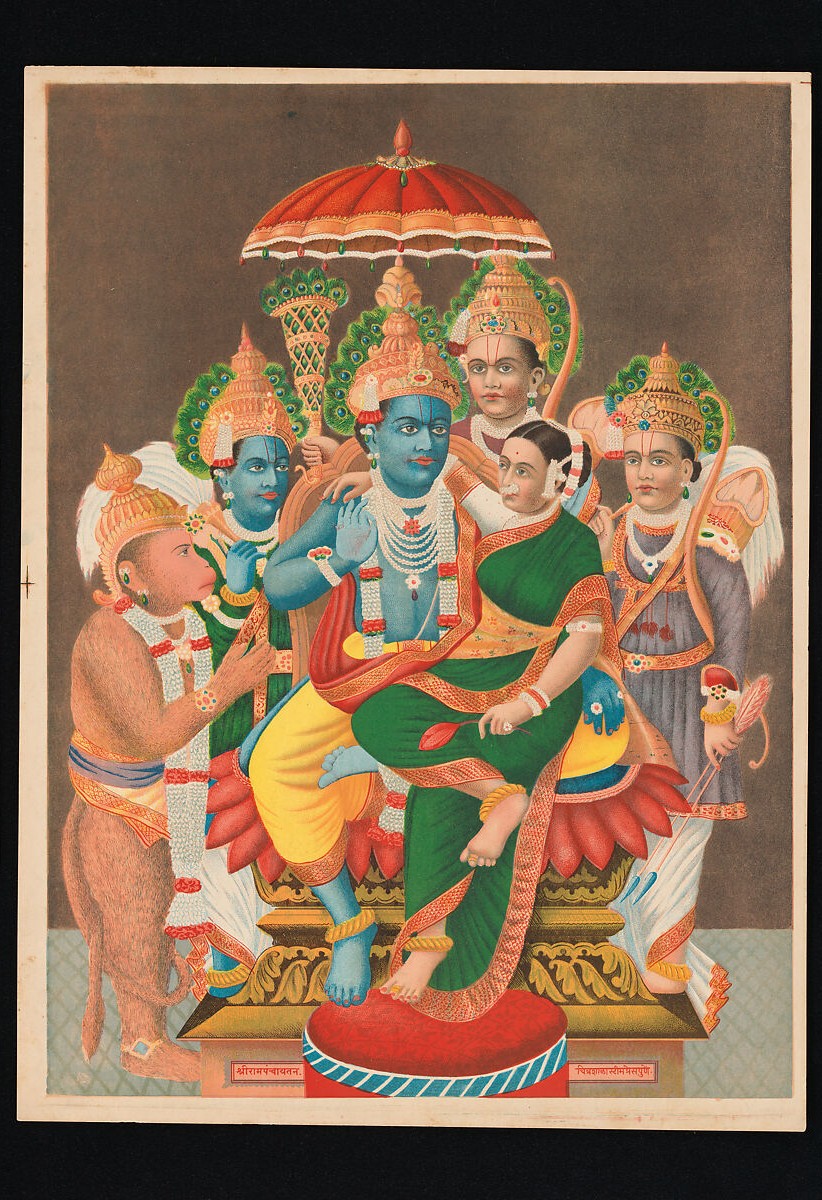
Chitrashala Press, Pune, India; The Metropolitan Museum of Art · Public domain / The Met Open Access
View the collection record ↗Cropped horizontally from the museum open-access image to remove the reproduction scale and excess black scan margin; subject and printed work remain intact.
Sources
Keep reading and watching.
- Valmiki Ramayana 1.1: Narada tells Rama's story | IIT Kanpur ↗
- Sita and Rama: The Ramayana in Indian Painting | The Met ↗
- Ramlila, the traditional performance of the Ramayana | UNESCO ↗
Infinite Hand honors Rama as a living focus of devotion and draws from selected Ramayana and Vaishnava traditions. These reflections are ours and do not define Rama for every devotee or settle the epic's contested episodes.
More people and stories