
Patron saint of the future imposed on everyone else
Leto II
Leto II is here as a warning. A ruler promises humanity a distant future and demands obedience for thousands of years to deliver it. We want to think beyond our lifetimes. We also want the people alive now to have a say in the future being built around them.
- Stewardship
- Power
- Reversibility
01 · Context
The Golden Path and everyone living under it.
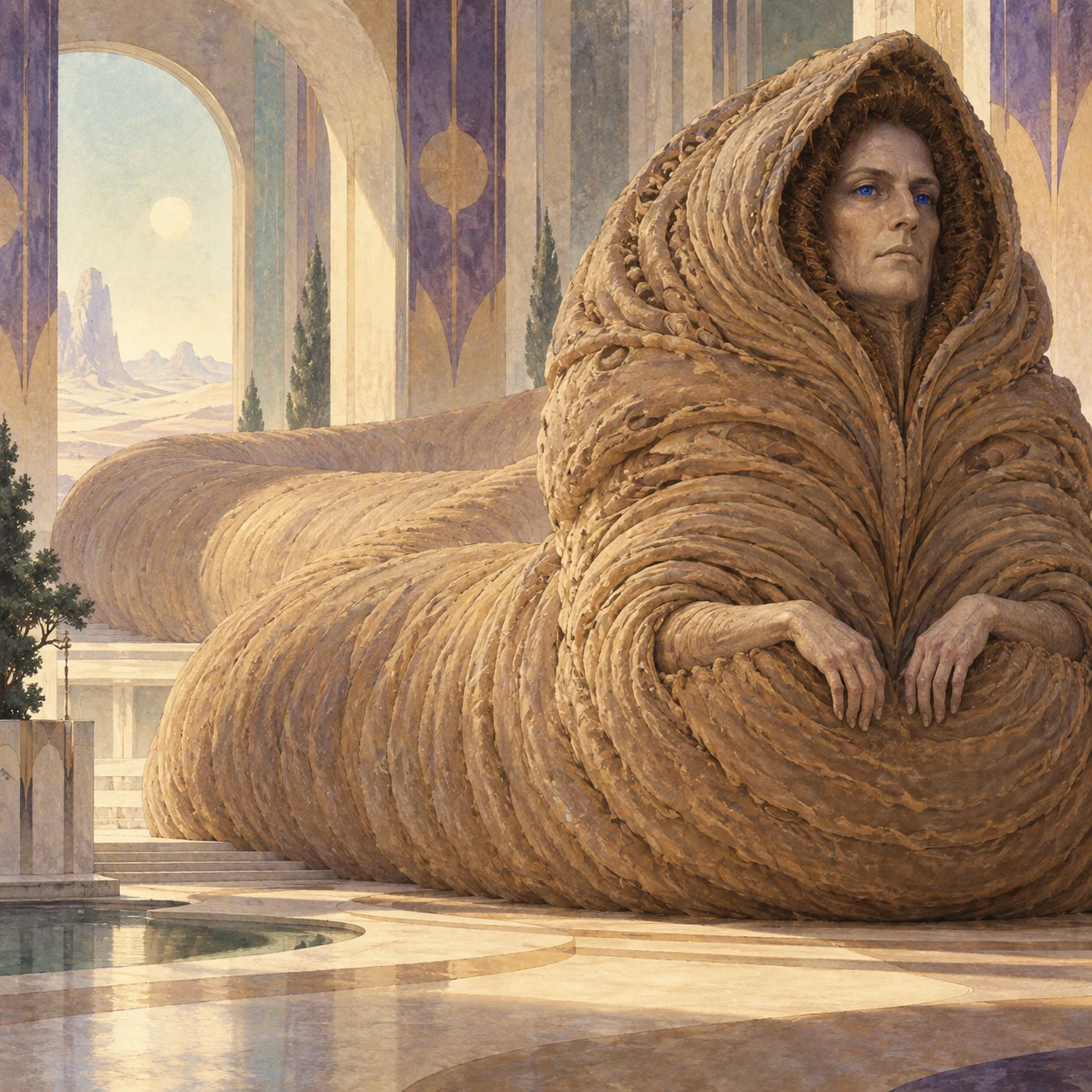
Leto II is Paul Atreides’s son in Frank Herbert’s Dune novels. By God Emperor of Dune, he has combined with a sandworm and ruled for roughly three and a half millennia. Arrakis has changed under that extraordinarily long reign.
The publisher describes a tyrant whose plans follow the Golden Path, with Siona of the Atreides family rebelling against him. His claimed knowledge of humanity’s future drives the conflict. Herbert can give a fictional ruler foresight; a real leader still has to show their evidence.
Read the sources ↓02 · Infinite Hand’s reflection
What we take from it.
These are Infinite Hand’s interpretations. Bring your own reading to the conversation.
Include living people in the long plan
Think about generations ahead and the people carrying the costs today. Ask which burdens they can choose and how they can object. A promised benefit deserves scrutiny from those expected to pay for it.
Build in ways to change course
Keep disagreement, alternative knowledge, and review dates in the plan. People need a way to identify a mistake and act on it. Protect that ability as the project grows.
Make yourself replaceable
Share knowledge, teach others, and plan for succession. Let more people make decisions. The community should be able to keep going when you leave.
03 · The difficult part
A future imposed is still coercion.
No horizon is wide enough to excuse removing everyone else's exits.
Leto’s fictional foresight can make domination look like the price of survival. A real leader cannot borrow a novelist’s control of the future as proof that their plan is necessary. Ask for alternatives and keep a way to refuse, revise, or leave.
04 · Bring it into today
Try something from this.
- When someone says there is only one possible course, ask about their assumptions and the alternatives they considered.
- Add a review date and a fair way to leave or propose changes to a long commitment.
- Document a process or teach a responsibility that currently depends on you. Share access appropriately.
05 · Exit-route audit
Can the plan be refused or reversed?
Stress-test a long-term plan before certainty hardens into control.
Private by design: nothing you write here is sent or stored. Copy it before leaving if you want to keep it.
06 · Look a little closer
Images, history, and credits.
Created for Infinite Hand with AI · AI-generated character illustration
About this illustration
Created for Infinite Hand with AI on 2026-09-08. This is an interpretation of the character; it is not an official production image.
The characters belong to their respective creators and rights holders. This illustration does not imply their affiliation with or endorsement of Infinite Hand.
Read the illustration prompt
Use case: illustration-story. Asset type: square character feature illustration for Infinite Hand, 1024 by 1024 pixels. Create a new original interpretive illustration of the older Leto II, God Emperor of Dune from Frank Herbert's novel, during his later sandworm transformation. Use text alone, no reference image, book-cover imitation, or actor likeness. Subject and anatomy: an enormous, elongated, ribbed tan sandworm-like body reclining in a grand quiet palace, with a recognizable small human Atreides face embedded at the front within a protective cowl of worm skin, intense blue-within-blue eyes, and exactly two small human-shaped arms and hands just below the face. His immense body should read as a sandworm, not a human wearing armor, a snake, a dragon, or Duke Leto. Keep his entire face, cowl, and both small arms clearly inside the frame. Frame enough of the long heavy body curving back into the chamber to establish his transformed anatomy and scale. Expression and mood: dignity, deep intelligence, isolation, and the burden of centuries. No violence or gore. Style: refined gouache and editorial illustration with delicate paper texture, warm cream palace light, sandy ochre body tones, muted mint and violet shadows. This is an original artistic interpretation of a fictional literary character, not canonical franchise art or a photograph. No text, labels, logos, watermark, or borders; no additional people.
Saved as WebP for faster loading; original composition and dimensions retained.
Sources
Keep reading and watching.
An independent Infinite Hand cultural and spiritual reflection. Inclusion does not imply affiliation or endorsement by the figures, performers, creators, or rights holders.
More people and stories