
The song that travels between worlds.
Narada
Narada is a devarshi, a divine sage, musician, storyteller, and devotee who moves between earthly and heavenly realms. He carries news, questions, warnings, and the names of the Divine, often arriving when a hidden truth must enter the story. Infinite Hand works with Narada whenever a message must travel faithfully and truthful speech must set something in motion.
- Transmission
- Devotion
- Consequences
01 · Context
A song crosses worlds and an epic begins.
At the opening of the Valmiki Ramayana, Valmiki asks Narada whether a person of complete virtue can be found. Narada names Rama and tells his story in brief. Brahma then instructs Valmiki to compose the epic as he heard it from Narada, making the divine sage a bearer through whom the sacred story begins.
Across epic, Puranic, and Vaishnava traditions, Narada travels with a vina and devotion to Vishnu, advising gods, sages, and rulers. His arrival can bring wisdom, but it can also provoke, expose, or redirect events. Popular portrayals sometimes make him a comic gossip, while devotees know a revered sage whose words have consequences.
Read the sources ↓02 · Infinite Hand’s reflection
What we take from it.
These are Infinite Hand’s interpretations. Bring your own reading to the conversation.
Carry the message faithfully
Do not improve a message by changing what it means. Listen closely, preserve what matters, and let the receiver know where your own interpretation begins.
Keep devotion in the voice
Narada's speech travels with song and remembrance of the Divine. Let communication carry reverence, especially when speed makes it easy to forget the person at the other end.
Own what speech sets in motion
A true word can still be timed badly or spoken for vanity. Before sending it, ask whether it serves truth, healing, or only the wish to be important.
03 · The difficult part
A true message can still serve vanity, spectacle, or harm.
Carry the message without confusing your voice for its source.
Narada sometimes provokes conflict or reveals what others hoped to hide. That complexity should not be sanitized, but neither should he be flattened into a meddler or a god of email. A message can uncover truth or feed ego, so responsibility for speech remains at the center.
04 · Bring it into today
Try something from this.
- Before sending one important message, read it once for truth, once for tone, and once for what it may set in motion.
- Carry one piece of good news, needed warning, or sincere gratitude to the person who should receive it.
05 · Transmission check
Truth. Tone. Consequence.
Prepare a message that preserves meaning and remembers the life at both ends of the route.
Private by design: nothing you write here is sent or stored. Copy it before leaving if you want to keep it.
06 · Look a little closer
Images, history, and credits.
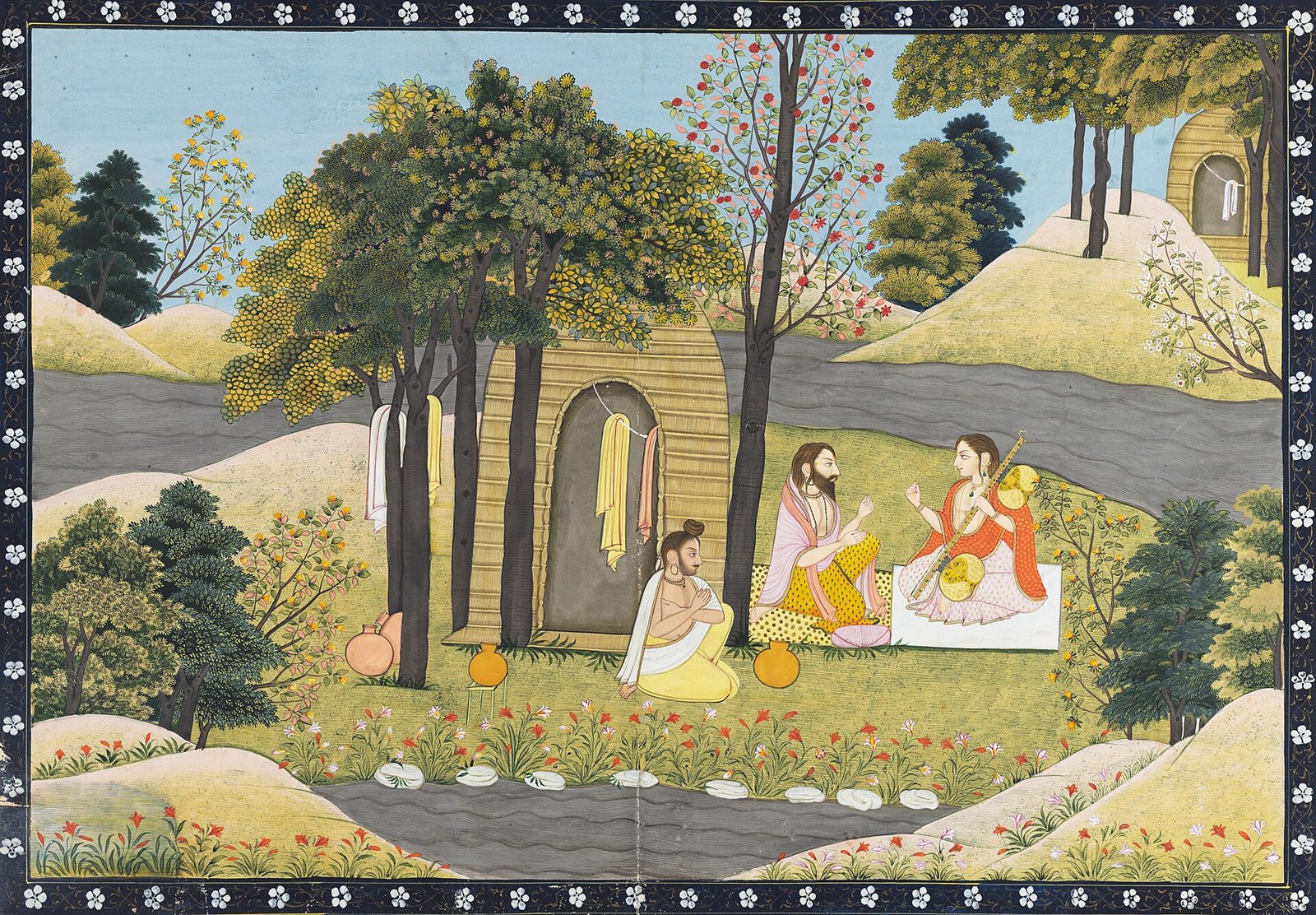
Unknown artist, Kangra style; National Museum, New Delhi · Public Domain Mark 1.0
View the collection record ↗
Resized for web display; full composition retained.
Sources
Keep reading and watching.
- Valmiki Ramayana 1.1: Narada tells Rama's story | IIT Kanpur ↗
- Bhagavata Purana 1.5: Narada counsels Vyasa | Vedabase ↗
- Narada Bhakti Sutras | Ramakrishna-Vivekananda archive ↗
Infinite Hand honors Narada as Devarshi and devotee, not as a Western-style god assigned a single portfolio. This profile draws from selected Ramayana, Puranic, and Vaishnava traditions.
More people and stories